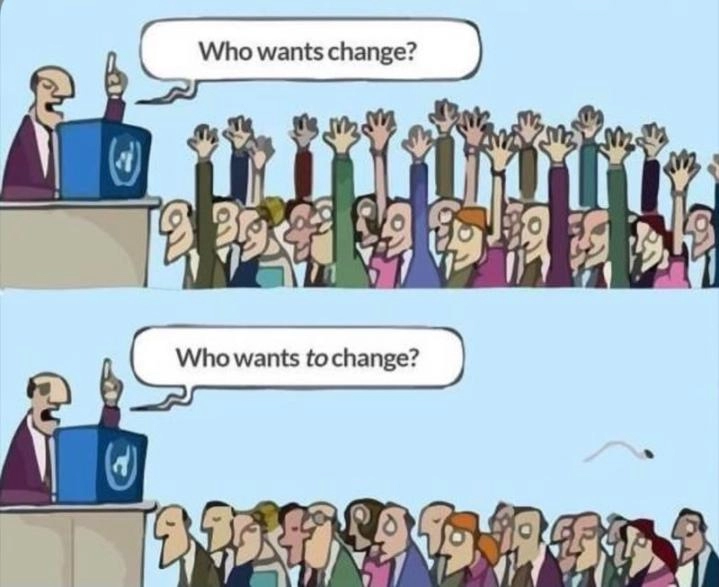
This course has already covered a lot.
From thinking in multiple futures to stretching your imagination.
However, one important factor is still missing: people.
Because plenty of people claim they like change. But in practice, it's different.
Human behaviour is also influenced by technology.
Indeed, our attitude toward technology changes over time.
Sometimes it’s like a hurtling train.
Suppose you are absolutely against the use of facial recognition in demonstrations; it might seem like there is nothing you can do about it. Nothing intervened in the progress of the refrigerator and the printing press, did it?
Bias.
An assumption that affects our thinking is also referred to as a bias. Rabia explained the status quo bias in an earlier excerpt. These (un)conscious assumptions limit our ability to think about the future.
Rather a bird in the hand.
An example of bias is time preference. This means that we consider things in the present more important than things in the future. You may just miss out on an extra marshmallow, or the interests of future generations may not be considered in our decisions.
Theoretically possible.
However, if you hear this explanation after the fact, it may be a case of cognitive dissonance. After all, our brain is working hard to align our words and actions. If you don’t manage to keep the marshmallow, you’re going to convince yourself that it was a good idea to eat that marshmallow anyway.
Look in the mirror.
So, it is challenging to stay objective when considering the future. It doesn’t matter if you’re talking about your future or our common future.
All beginnings are difficult.
Now that you’re almost a real futures thinker, you may be wondering where to start to get things moving. Fortunately, that’s easier than many people think, and what starts small can grow surprisingly quickly. That’s what the next module is about.